Corrections
This page exists because a site arguing that a city should act on evidence has to be correctable itself. It lists errors we found in widely circulated community materials, errors we made ourselves, and the claims we deliberately declined to publish because we could not verify them.
Report an error
If anything on this site is wrong, we want to fix it. Email corrections@deflock-deerpark.org.
For anything that is not a correction — a question, a document, a request to speak with us — write to contact@deflock-deerpark.org. To ask for the sources behind a specific claim, or for a printable copy of any page to hand to a council member, write to info@deflock-deerpark.org.
The most useful correction identifies the page, quotes the sentence, and points at a source. We will correct the page and log the change here, including when the correction comes from the City of Deer Park, its police department, or Flock Safety.
If you are with the city or the department: if a written ALPR policy, contract, or audit report exists that we could not find, send it and we will publish it and correct every page that says it is not published. Several statements on this site are of the form "not published on the city website, checked July 29, 2026." Each of those is one document away from being retired.
Corrections to materials circulating elsewhere
These are errors in community toolkits and advocacy materials about Flock that we checked and found wrong. We list them because a council member who verifies one inflated figure is entitled to distrust every other number they were given — including ours.
The CVE count is 15, not 22
The claim in circulation: Flock Safety has 22 confirmed CVEs.
What we found: A search of the National Vulnerability Database for "Flock Safety" returns 15 records, which we checked against the database itself on July 29, 2026 rather than against anyone's summary of it.1
A looser search does turn up roughly 30 records, but the extra ones are unrelated — vulnerabilities in the Linux kernel's flock() system call, and an unrelated product's authorization bypass. The 22 figure appears to come from counting some of those, or from conflating CVEs with the 51 individual findings in the underlying security researcher's white paper. Findings and CVEs are different units.
We use 15. The full table is on the security page.
CVE-2025-47822 is Medium, not High
The claim in circulation: CVE-2025-47822 is rated High severity.
What we found: NVD rates it Medium, CVSS 6.4.1
Mountain View was four months and one camera, not 17 months
The claim in circulation: Federal agencies accessed Mountain View's ALPR data for 17 months.
What we found: Mountain View's own city bulletin describes access from August to November 2024 — roughly four months — affecting data from one camera.2
The underlying event is real and serious: the access occurred through a nationwide search setting "enabled without MVPD's permission or knowledge," and the city ultimately disabled all 30 cameras and terminated the contract.2,3 The duration figure is simply wrong, and using it makes the true version easier to dismiss.
The Flock patent's demographic language is in the description, not the claims
The claim in circulation: Flock holds a patent describing classification of people by sex, race, height, weight, and clothing — cited as evidence that Flock cameras profile people by race.
What we found: Patent US 11,416,545 B1 does contain that language, in its description — the portion explaining possible implementations. We counted occurrences across all 20 granted claims, which is the part defining the legally protected invention: male 0, female 0, race 0, gender 0, height 0, weight 0, clothing 0.4
A patent shows what a company thought worth describing and protecting. It is not evidence about what software runs on a pole in Deer Park. We state the qualification wherever we mention the patent.
The Oak Park "no evidence whatsoever" quote needs two qualifications
The claim in circulation: Oak Park's oversight committee found no evidence Flock cameras aided any investigation, proving the cameras do not work.
What we found: The quotation is accurate, but it circulates without the two things that most affect its meaning.5
First, the finding rests on the police department declining to supply outcome data to its own oversight committee — the committee's words are "despite repeated requests by CPOC for evidence of 'successful investigative outcomes' … OPPD remains unwilling to provide such data." That is a finding about missing information, not a study showing failure.
Second, the same report credits those two stops with four arrests and two firearms recovered. Anyone quoting this report has an obligation to say so, and we do on every page where it appears.
What Oak Park's numbers do establish is the ratio: 373 searches of residents' movement data against 2 stops in six months.
Ohio HB 725 would not regulate police ALPR use
The claim in circulation: Ohio has a pending license plate reader bill.
What we found: HB 725 restricts ALPR data use for commercial purposes. Division (C)(2) exempts law enforcement agencies and peace officers by name, and division (C)(3) exempts public-entity-to-public-entity sharing.6
Even if it passed tomorrow it would change nothing about Deer Park's program. There is no pending Ohio bill that would regulate police ALPR use. Full text quoted on the Ohio law page.
Chatrie is not an ALPR decision
The claim in circulation: The Supreme Court has ruled that license plate reader surveillance requires a warrant.
What we found: Chatrie v. United States (June 2026) held that obtaining a person's cell-phone location data was a Fourth Amendment search. We read the full opinion: it does not mention license plate readers or automated license plate recognition anywhere.7 It concerns a geofence warrant for Google location data.
Commentators, including in Ohio, have asked whether ALPRs are next.8 That is a prediction about where the law may go, not a holding. Separately, the one federal court that has examined a municipal Flock network — in Norfolk, Virginia — ruled for the city.9
The Central Ohio $2 million figure is cumulative, not annual
The claim in circulation: Central Ohio departments spend nearly $2 million a year on Flock cameras.
What we found: WOSU's figure — 319 cameras across 15 departments, nearly $2 million — is cumulative spending across contract terms, not an annual rate. Treating it as annual overstates the per-camera cost roughly 2.5-fold. WOSU also notes its tally is likely an undercount because several departments did not respond.10 Worked through on the cost page.
Our own corrections
We were wrong that the Institute for Justice census did not exist
What we got wrong: During research, working from a broken URL, we concluded that the IJ 27-case wrongful-stop census did not exist and planned to cite a secondary compilation instead.
The correction: It exists.11 The URL we had been given was wrong, not the source. We verified every figure we use from it directly against IJ's own page: 27 cases since 2018, guns drawn in nearly two-thirds, roughly one-third machine misreads, Flock's "93 out of every 100" accuracy claim, and the implication of more than a billion bad reads per month.
We log this because it is the same class of error as the ones above — a claim about a source we had not read — and it would be dishonest to list other people's and not our own.
We upgraded the terms-rewrite sourcing rather than rely on an analyst
What we changed: Our original plan cited the 147-change figure for Flock's February 2026 terms rewrite to a self-published analysis by a named independent analyst who states they are not an attorney.
The correction: We downloaded both versions of Flock's contract — December 20, 2025 and February 16, 2026 — and read them ourselves.12,13 Every specific clause change on this site was confirmed against the underlying documents: the removal of "Flock does not own and shall not sell Customer Data," the deletion of section 4.3 on training data, the addition of "perpetual" to the license grant, the disappearance of the gross-negligence carve-out, and the change of governing law from the customer's home state to Georgia with mandatory arbitration.
The change count of 147 remains the redline tool's, and we label it as such.14 The individual changes are our own reading of Flock's text.
We overstated what Cleveland's amendment actually contains
What we got wrong: Our page for the police department listed seven contract terms and said Cleveland's council "obtained all of them from this vendor in a single amendment."
The correction: We re-read the amendment to Ordinance 683-2026 line by line.15 Five of the seven are in it: warrant-only disclosure, advance notice with an opportunity to seek protective relief, a penalty of up to 25 percent of contract value, a named sharing prohibition (the Northeast Ohio Regional Fusion Center), and quarterly written reporting plus a public transparency portal.
Three were not. The amendment contains no retention cap, no published approved-use list, no requirement to report false hits or stops specifically, and no hotlist review interval. The page now separates the five Cleveland won from the three we would ask for anyway.
This is the exact error we criticize elsewhere: attributing to a primary document something the document does not say. It was ours.
We described Flock as a plate-reader company when its catalog is wider
What we got wrong: Our how-it-works page listed what "the cameras" do not do — no continuous video, no facial recognition — in a way that read as a description of the company rather than of the Falcon plate reader. It was accurate about Deer Park's hardware and too narrow about the vendor.
The correction: Flock's own marketing to parks agencies sells video cameras, gunshot and audio detection, mobile trailers, and drones alongside plate readers.16 Its video product page advertises pan-tilt-zoom cameras with a "32x zoom," fixed cameras for "areas that require constant recording," and a feature set including "People Detection Alerts."17 The page now separates the Falcon from the catalog.
This changes nothing about Deer Park, which is documented as operating nine plate readers and nothing else.18 It changes what we should have said about the vendor.
We attributed two device categories to a document we could not re-open
What we got wrong: Describing Leonardo's SignalTrace, we wrote that the device categories in its product sheet include pet microchips and tire pressure sensors, citing Leonardo's page. Leonardo's page does not say that. It names "fitness trackers, smartwatches, RFID tags and mobile phones."19 We had taken the longer list from the brochure posted to DocumentCloud, and when we went back to check it word for word, we were no longer able to open that copy.20
The correction: Pet microchips are now attributed to the secondary reporting that actually carries them, with that reporting's own hedge that Leonardo's materials "suggest" the capability.21 Tire pressure sensors are removed entirely, because we cannot source them. The revised passage is here.
We are logging this at length for a reason. The claim was in the right direction and about the right company, and we still could not stand it up as written. That is the standard we are asking a council member to hold us to, so it is the standard we have to apply when the error is ours.
We sharpened the language about Flock and should say what we did and did not change
What we changed: On July 29, 2026 we revised the claims, Flock's responses, home, council and misuse pages to state the vendor-conduct record more directly — including describing Flock's denial of a DHS relationship as false rather than as a discrepancy, and adding a section on the gap between the company's accountability claims and what its audit trail can detect.
No factual claim was added without a primary source, and none was strengthened beyond its source. The material was already in the record we had gathered; what changed is that we stopped hedging findings the documents establish. Specifically:
- The DHS denial is described as false because Flock said so, in language quoted in Sen. Wyden's October 16, 2025 letter: customers "were inaccurately informed that Flock did not have any relationship with DHS, while pilot programs with sub-agencies of DHS were briefly active."22 We downloaded and read that letter in full rather than relying on reporting about it.
- "Flock deceived its law enforcement customers" is quoted and attributed to Wyden, who is a Senator conducting oversight with a stated position, not a court.22 We do not assert deception in our own voice, and we did not add any claim about Flock's intent.
- The audit-limitation point is quoted from the ACLU, labeled advocacy, and corroborated independently by Wyden's own finding about generic search reasons.23,22
- Flock's June 19, 2025 CEO statement is now quoted directly rather than summarized, including the parts that favor the company — the trafficking, burglary and retail-theft cases, and the fact that Flock audits by default where most jurisdictions do not require it.24
What we deliberately did not do. We did not remove any counterargument. Flock's self-registered CVEs, its CISA Secure By Design pledge, the Oak Park stops that produced four arrests and two firearms, the Norfolk ruling for the city, and the Deer Park chief's statement about hit-skip reports are all still on the site in the same places.25,5,9,26 We also flagged, rather than resolved, a conflict between Flock's CEO saying the company "engaged in limited pilots" with CBP and the Illinois Secretary of State's account that the CBP pilot was one "which Flock leadership was unaware of."27 We do not know which is accurate and we say so.
We log this because a site that gets more pointed owes its readers an account of whether the evidence got stronger or only the adjectives did. In this case it was the evidence: the primary Wyden letter and Flock's own statement, both read in full.
We narrowed the Volusia County description
What we changed: We initially described the Volusia County, Florida case as a plate-reader error.
The correction: The camera read the plate correctly. Lindsay Isaacs' car genuinely was near the road. The error was in what investigators built on top of an accurate read — a black SUV on camera plus a witness description became probable cause, and the vehicle that caused the crash was maroon.28
The corrected framing is more useful anyway: a plate reader does not have to malfunction to contribute to a wrongful arrest.
We were using Dayton as a good example, and Dayton had already collapsed
What we had: Five pages of this site cited Dayton, Ohio simply as an Ohio city that "publishes a public ALPR disclosure page" — offered as a low bar Deer Park had failed to clear.29
What we missed: By the time we wrote that, Dayton's program had already failed and been suspended. In 2026 the city found roughly 7,100 immigration-related search requests in its own Flock data from outside agencies, in violation of the very policy it had published; it cut off federal access in January, shut off all sharing on April 7, suspended the fixed-site program, and by late May had covered all 72 cameras with trash bags.30,31,32,33 Dayton's city website still shows only the 2022 policy approval and says nothing about any of it.29
How we got it wrong: We checked whether Dayton had published a policy, found that it had, and did not check what had happened to the program since. A city's own transparency page is a record of what it decided, not a record of how it turned out.
What changed on the site: Dayton now has the longest entry on the other cities page and a section on the home page, and the four other pages that cited it now say what it published and what happened. The reframing cuts against a point we had been making — it is no longer true that a published policy is the fix — so we say so directly: Dayton is evidence that policy without auditing does not hold. That strengthens the case for auditing and weakens any argument that Deer Park could settle this by posting a document.
We missed that Ohio exempted plate reader data from the Public Records Act
What we had: Our Ohio law page opened by saying Ohio has no ALPR statute, and our action and residents pages presented the Public Records Act as an unqualified lever for getting information about the program.
What we missed: Effective September 30, 2025, R.C. 149.43(A)(1)(yy) excludes from the definition of "public record" any "Images and data captured by an automated license plate recognition system that are maintained in a law enforcement database."34 We verified the change by comparing statute versions: the clause is absent from the version effective April 9, 2025 and present in both the current text and the version effective September 7, 2026.34,35 The listed legislation for the September 2025 version is House Bill 96, the state budget bill.34
How we got it wrong: We searched for an Ohio statute regulating police use of plate readers, found none, and reported that accurately. We did not check whether Ohio law said anything about plate readers at all — which it does, in the Public Records Act, in a chapter we were already citing on four pages. Looking for the law we expected is how we missed the law that was there.
What changed on the site: The Ohio page now has a section on the exemption, and its standfirst says so. The action page carries the clause and explains how to word a request around it, and item 7 of the request template now states expressly that it does not seek plate images or reads. The residents page carries the caution.
Both directions, stated fairly. This cuts against us: a resident cannot obtain the plate reads, so the check we were pointing people toward is narrower than we described. It also cuts for the central argument, and we would rather a council member hear us make the fair version. Nothing in the clause exempts a contract, an invoice, a policy, an ordinance, or vendor correspondence, and whether it reaches a search audit log is genuinely unsettled — an audit log records who searched, not what a camera captured. And there are defensible privacy reasons for the exemption itself, which we say on the Ohio page rather than treating the clause as inexplicable. What follows is that when the data is exempt from public inspection, oversight can only come from the department or the council. Neither has published anything.36
We described the records remedy as stronger than it is
What we had: Three pages said that if records are wrongly withheld, R.C. 149.43 provides a mandamus action with statutory damages of $100 per business day up to $1,000, plus court costs and reasonable attorney fees. We took that from Section 5 of Deer Park's own published policy.37
The correction: Accurate as far as it went, and incomplete in three ways we should have caught by reading the statute rather than the city's summary of it.34 Statutory damages run from the day the requester files the action, not from the day the office stopped responding. Before filing, a requester must serve a complaint, allow three business days to cure, and file a written affirmation that they did — without which "the suit shall be dismissed." And a court may reduce or decline damages, and must decline attorney fees, where a well-informed public office would reasonably have believed its conduct was lawful.
What we also omitted entirely: the remedy an ordinary resident would actually use. R.C. 2743.75 provides a $25 complaint to the Court of Claims, decided by a special master after mandatory mediation, recovering the filing fee and costs — but expressly no attorney fees.38 A requester may use one route or the other, not both. That route did not exist when Deer Park adopted its policy in 2007, which is why the policy does not mention it, and R.C. 149.43 has been amended roughly twenty times since.37,34
Why we are logging a correction that makes our own advice less exciting: the person most likely to rely on this page is a resident with no lawyer. Overstating a remedy to that reader is worse than understating it.
We cited the wrong city page for the council roster, and we should say what the city's own form does
What we got wrong: Three pages cited the city's City Council landing page for council members' names, titles, terms and email addresses. That page does not carry them. The roster and the Clerk of Council's contact information are on the Elected Officials subpages, and the meeting schedule sentence we quote is on the council minutes index.39,40,41
The correction: Every name, title, term expiration and email address on this site matched the city's published pages exactly — we re-verified all eight against the correct pages, and nothing changed. Only the citations were wrong. We are logging it anyway, because a citation that does not support the claim is the specific failure we criticize on other pages, and a reader who clicks through and finds nothing has no way to tell a bad citation from a bad fact.
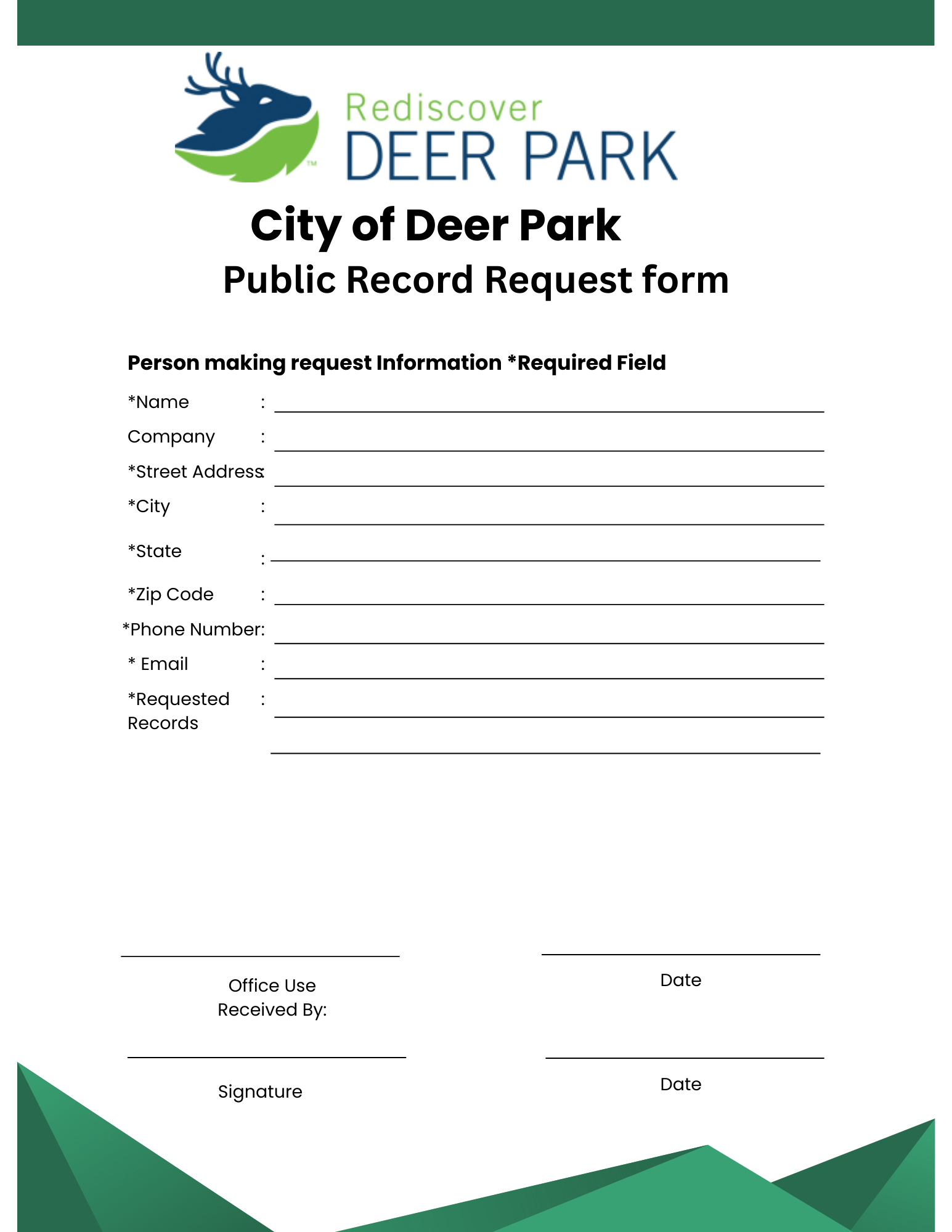
One thing we found while checking. The city publishes a Public Record Request Form as a PNG image, and it marks name, street address, city, state, ZIP, phone and email as required fields.42 Ohio law does not permit a public office to require any of that: R.C. 149.43(B)(4) provides that such a requirement "constitutes a denial of the request," and Deer Park's own policy says the same at Section 2.2.34,37 We do not read this as an attempt to deter anyone — a 2007 policy and a scanned form have simply drifted apart. But residents should know the form is optional and a plain email is a complete request, so the action page now says so.
Claims we declined to publish
Listed because what a site chooses not to say is part of how it should be judged.
- A $14,196 figure from the Hamilton County Auditor's Real Estate Assessment Fund for five cameras. Sourced to a post in a local politics group on social media, and it conflicts with the confirmed nine-camera count. We publish the $14,000 figure that appears in the council minutes instead.43
- That Deer Park has no ALPR policy. We say only that none is published on the city website, checked July 29, 2026 across the police department pages, the contacts page, the records policy, and the auditor's reports.36 An internal general order may exist. If it does, no resident can read it.
- That Deer Park participates in Flock's National Lookup. The Atlas of Surveillance obtained Deer Park's camera count from another agency's shared-devices list, which establishes the deployment is visible outside the city.18 It does not establish that outside agencies can search Deer Park's reads, and we do not claim it does.
- Any specific dollar figure for Deer Park's contract. Every cost figure on this site other than the $14,000 is labeled an estimate derived from another city's published rate.44,45
- That Deer Park's data has been breached, sold, or accessed by federal agencies. We have no evidence of any of it.
- That Flock cameras perform facial recognition. The plate readers record vehicles, not faces.
- That Flock tracks Bluetooth, Wi-Fi, or radio signals from phones, earbuds, or pet tags. The product this describes is real, but it is ELSAG SignalTrace, made by Leonardo, a competing vendor.19,20 We found no evidence Flock sells or has announced any such capability, and no Flock statement on it either way. The claim is circulating widely with Flock's name attached, and attaching it to the wrong company is how a checkable argument gets thrown out.
- That Flock has any stated position on tracking pet tags. Pet microchips appear in secondary reporting about Leonardo's product materials, not in any Flock statement — and not on the Leonardo page we were able to read, which names only "fitness trackers, smartwatches, RFID tags and mobile phones."19,21
- That any plate-reader product tracks tire pressure sensors. An earlier draft of our how it works page said Leonardo's brochure named them. We could not confirm it, and we withdrew the claim; the fuller device list we relied on came from a DocumentCloud copy of the brochure that is no longer reachable.21,20
- That Flock sold a contract off the demonstration in which its sales staff viewed a children's gymnastics camera. The viewing is documented in released records and reported by four outlets.46,47,48 We found nothing identifying the prospective agency or any resulting sale, and we do not publish the circulating count of how many times a named executive opened the feed — our sourcing for that figure is a Substack post and a second-hand summary we could not trace back to the released records. What the record does support is on the claims page.
- That a Flock camera was installed inside a children's gymnasium. The camera belonged to the Marcus Jewish Community Center of Atlanta and was linked to police through Flock's Camera Connect service.48
- That anyone in the Deer Park Police Department has misused the search system. We have no evidence of it and say so on the misuse page, which is about the absence of any mechanism that would reveal misuse if it occurred.
- That Flock has paid settlements to wrongly stopped drivers. We found none. The one confirmed payout in the record was paid by the City of Toledo.49
- Details of the Morristown, Tennessee stop beyond the misread itself. Our strongest source is a television station's social media post rather than its own article; we could not confirm the date or whether a claim was filed. We flag it in place as weakly sourced.50
Our standing commitments
- Distinguish "not published, checked on a date" from "does not exist."
- Distinguish court holdings from commentators' predictions.
- Label every source by type, including the ones that agree with us.
- Publish nothing about individual Deer Park officers or employees beyond their public roles and published contact information.
- State the counterargument. The chief has said the cameras help with hit-skip reports; Oak Park's two stops yielded four arrests and two firearms; one federal court has ruled for a city on these facts.26,5,9
- Fail the build rather than ship an uncited claim. This site's citation system throws an error if a citation does not resolve to a source, so a page with an unsourced claim cannot be published by accident.
Sources
- Federal vuln. database Search for "Flock Safety" in the National Vulnerability Database. National Institute of Standards and Technology. Queried July 29, 2026. nvd.nist.gov/vuln/search/results?query=Flock+Safety ↑1↑2A search of the federal government's vulnerability database for "Flock Safety" returned 15 records on July 29, 2026. We counted them from the database itself, not from anyone's summary of it.Retrieved July 29, 2026.
- Government record Update on Automated License Plate Reader Program. City of Mountain View, California. January 30, 2026. content.govdelivery.com/accounts/CAMOUNTAINVIEW/bulletins/406f640 ↑1↑2The city's own bulletin, distributed through its subscriber notification service. We link this copy because the identical page on mountainview.gov is not publicly readable without a browser session.Retrieved July 29, 2026.
- News reporting City Council terminates Mountain View's license plate camera contract. Mountain View Voice. February 25, 2026. www.mv-voice.com/city-government/2026/02/25/city-council-terminates-mountain-views-license-plate-camera-contract ↑Local reporting on the termination vote. The city's own news release covers the same vote but is not publicly readable outside a browser session, so we cite the newspaper.Retrieved July 29, 2026.
- Flock Safety US Patent 11,416,545 B1: System and method for object based query of video content captured by a dynamic surveillance network. Flock Group Inc. (assignee); inventors Garrett Langley and Matt Feury. Granted August 16, 2022. patents.google.com/patent/US11416545B1/en ↑Filed October 4, 2020, priority date May 1, 2018. The description proposes neural networks to 'identify different classes of people (male, female, race, etc.)', to identify clothing types and to gauge height and weight. We checked all 20 granted claims: none of the words male, female, race, gender, height, weight or clothing appears in the claims themselves. A patent shows what a company sought to protect, not what any camera in Deer Park does.Retrieved July 29, 2026.
- Government record Citizen Police Oversight Committee Semi-Annual Report, July 2024 through December 2024 (File MOT 25-162). Village of Oak Park, Illinois. May 20, 2025. oak-park.legistar.com/LegislationDetail.aspx?ID=7398514&GUID=14AA7E20-50B7-4635-90C7-8797D84B43CF ↑1↑2↑3Received by the Village Board on May 20, 2025. The report PDF is an attachment on this Legistar record. The committee's 'no evidence whatsoever' finding rests on the police department declining to supply investigative-outcome data, and the same report credits the period's two Flock-prompted stops with four arrests and two firearms recovered.Retrieved July 29, 2026.
- Government record House Bill 725, 136th General Assembly, as introduced. Ohio Legislative Service Commission. March 3, 2026. search-prod.lis.state.oh.us/api/v2/general_assembly_136/legislation/hb725/00_IN/pdf ↑Two-page bill text. The Legislature's site notes that online versions of legislation are not official.Retrieved July 29, 2026.
- Court record Chatrie v. United States, No. 25-112, 609 U.S. ___ (2026) (slip opinion). Supreme Court of the United States. Decided June 29, 2026. www.supremecourt.gov/opinions/25pdf/25-112_0am4.pdf ↑The opinion concerns a geofence warrant for Google Location History data. It does not mention license plate readers or automated license plate recognition anywhere.Retrieved July 29, 2026.
- News reporting Are Flock cameras next? Supreme Court rules against police using sprawling cell phone location data. Ohio Capital Journal. July 8, 2026. ohiocapitaljournal.com/2026/07/08/are-flock-cameras-next-supreme-court-rules-against-police-using-sprawling-cell-phone-location-data ↑Retrieved July 29, 2026.
- Advocacy org. Norfolk, Virginia camera surveillance (Schmidt v. City of Norfolk case page). Institute for Justice. ij.org/case/norfolk-virginia-camera-surveillance ↑1↑2↑3Filed October 21, 2024 in the U.S. District Court for the Eastern District of Virginia. District court decision January 26, 2026; appellate opening brief filed April 12, 2026.Retrieved July 29, 2026.
- News reporting Central Ohio police departments have spent nearly $2 million on Flock license plate cameras. Katie Geniusz, WOSU Public Media. April 28, 2026. www.wosu.org/politics-government/2026-04-28/central-ohio-police-departments-have-spent-nearly-2-million-on-flock-cameras ↑Based on public records requests to central Ohio police departments. WOSU notes its tally is likely an undercount because several departments did not respond and private businesses also contract with Flock.Retrieved July 29, 2026.
- Advocacy org. Dozens of Innocent Motorists Have Been Pulled Over, Detained at Gunpoint, or Jailed Due to AI License Plate Camera Errors. Institute for Justice; by Christopher Ingraham. July 1, 2026, updated July 20, 2026. ij.org/dozens-of-innocent-motorists-have-been-pulled-over-detained-at-gunpoint-or-jailed-due-to-ai-license-plate-camera-errors ↑A review of press coverage and court filings by a public-interest law firm that also litigates against ALPR programs, so it is an interested party. Finds at least 27 cases since 2018, most since 2023; guns drawn in nearly two-thirds; machine misreads about one-third of the mistakes, the rest officer data-entry or misreading. States the count is 'most likely an undercount.' Names Oak Park, Illinois as the only jurisdiction it found issuing routine error reports.Retrieved July 29, 2026.
- Flock Safety Flock Safety Customer Terms and Conditions, December 2025 version. Flock Safety (mirrored by haveibeenflocked.com). December 20, 2025. haveibeenflocked.com/blog/trojan-contracts/dec-2025-terms.pdf ↑The immediately preceding version of Flock's terms, mirrored. We downloaded and read this PDF directly on July 29, 2026 and confirmed the presence of the clauses that the February 2026 version omits, including section 4.1's sentence 'Flock does not own and shall not sell Customer Data' and all of section 4.3, Training Data.Retrieved July 29, 2026.
- Flock Safety Flock Safety Customer Terms and Conditions, last updated February 16, 2026. Flock Safety (mirrored by haveibeenflocked.com). February 16, 2026. haveibeenflocked.com/blog/terms-feb2026/feb-2026-terms.pdf ↑Flock's own contract text. Cited from a mirror because Flock's live terms page is rewritten in place each time the terms change and is not reliably archived; we downloaded and read this PDF directly on July 29, 2026 rather than relying on any third party's summary of it. Every quotation on this site from the February terms was verified against this file.Retrieved July 29, 2026.
- Advocacy org. Compare Results: 2025.12.20 Terms and Conditions versus 2026.02.16 Terms and Conditions. Machine-generated document comparison, published by H.C. van Pelt, footnote4a.org / haveibeenflocked.com. February 16, 2026. haveibeenflocked.com/blog/terms-feb2026/comparison-dec-feb.pdf ↑A software-generated redline whose summary page reports 147 total changes: 96 replacements, 21 insertions, 30 deletions, with the document growing from 12 to 15 pages. The accompanying commentary is self-published by a named analyst who states they are not an attorney, and we do not rely on it: we independently downloaded both the December 2025 and February 2026 terms and confirmed the specific clause changes cited on this site against the underlying documents.Retrieved July 29, 2026.
- Government record Amendment to Ordinance No. 683-2026 (as amended, desk copy). Department of Law, City of Cleveland. July 15, 2026. cityofcleveland.legistar.com/View.ashx?M=F&ID=15693899&GUID=7AC8CF89-050A-435D-88A7-7C46EF9C7726 ↑Two-page amendment signed by Assistant Director of Law Vishnu Ganglani. Cuts the term from one year to six months and the amount from $250,000 to $125,000; adds warrant-only disclosure, a penalty of up to 25 percent of the contract for privacy violations, a public transparency portal, quarterly written reports to the Clerk and Safety Committee, and a bar on sharing data with the Northeast Ohio Regional Fusion Center.Retrieved July 29, 2026.
- Flock Safety Flock for Parks & Rec — Parks & Public Spaces. Flock Safety. www.flocksafety.com/industries/parks-public-spaces ↑Flock's own marketing page for parks agencies. Flock revises its product pages in place and they are not reliably archived, so quotations are dated to the day we retrieved them.Retrieved July 29, 2026.
- Flock Safety Video Cameras. Flock Safety. www.flocksafety.com/products/video-cameras ↑Flock's own product page. Revised in place and not reliably archived, so quotations are dated to the day we retrieved them.Retrieved July 29, 2026.
- Advocacy org. Deer Park Police Department — Automated License Plate Readers (OH0310700ALPR). Atlas of Surveillance, Electronic Frontier Foundation and University of Nevada, Reno. September 2025. atlasofsurveillance.org/a/OH0310700ALPR ↑1↑2Derived from a Flock Safety shared-devices list obtained by public records request from another agency.Retrieved July 29, 2026.
- Flock Safety ELSAG SignalTrace Intelligence System. Leonardo US Cyber and Security Solutions. www.leonardocompany-us.com/lpr/elsag-signaltrace ↑1↑2↑3Leonardo is a different company from Flock Safety. SignalTrace is Leonardo's product; nothing in this material involves Flock.Retrieved July 29, 2026.
- News reporting This Company Will Add Phone, AirPod, and Smartwatch Trackers to License Plate Readers. Joseph Cox, 404 Media. June 8, 2026. www.404media.co/this-company-will-add-phone-airpod-and-smartwatch-trackers-to-license-plate-readers ↑1↑2↑3Paywalled beyond the opening paragraphs. The underlying Leonardo product sheet it reports on is posted to DocumentCloud, and we read that document directly. Flock Safety is not named in the article.Retrieved July 29, 2026.
- News reporting These License Plate Cameras Can Track Your Car By Your AirPods And Even Your Dog. Carscoops. June 18, 2026. www.carscoops.com/2026/06/signaltrace-plate-reader-tracking ↑1↑2↑3Secondary reporting on the 404 Media story about Leonardo's SignalTrace. We cite it only for the device categories it attributes to Leonardo's product materials, including pet microchips, which do not appear on Leonardo's own web page. It says those materials "suggest" the capability, and we carry that hedge. Flock Safety is not the subject of this article.
- Government record Letter to Flock Group, Inc. CEO Garrett Langley. U.S. Senator Ron Wyden. October 16, 2025. www.wyden.senate.gov/imo/media/doc/wyden_letter_to_flock.pdf ↑1↑2↑3Quoted directly from the Senator's published PDF. Reports that 75% of Flock's law enforcement customers had enrolled in the National Lookup Tool, and that in an EFF dataset of 11.4 million nationwide searches over six months, more than 14% of search reasons were the single word 'investigation' with no case number.Retrieved July 29, 2026.
- Advocacy org. Surveillance Supporters Tout Police Audit Logs But They're Not an Effective Check and Balance. Jay Stanley, American Civil Liberties Union. October 31, 2025. www.aclu.org/news/privacy-technology/tracking-alpr-cameras/police-audit-logs ↑Retrieved July 29, 2026.
- Flock Safety Setting the Record Straight: Statement on Flock Network Sharing, Use Cases, and Federal Cooperation. Flock Safety. June 19, 2025. www.flocksafety.com/blog/statement-network-sharing-use-cases-federal-cooperation ↑Signed by Flock's CEO. This is the statement we set against Sen. Wyden's October 2025 letter and the Illinois audit. Quoted from the live page on July 29, 2026. Flock revises its blog and legal pages in place and they are not reliably archived, so if the wording there has since changed, this note and the retrieval date are the record of what it said that day.Retrieved July 29, 2026.
- Flock Safety Response to compiled security research on Flock Safety devices. Flock Safety. November 6, 2025. www.flocksafety.com/blog/response-to-compiled-security-research-on-flock-safety-devices ↑Retrieved July 29, 2026.
- Government record City Council Minutes, April 20, 2026. City of Deer Park, Ohio. April 20, 2026. www.deerpark-oh.gov/media/user/council-meeting-minutes/Council%20Min%20April%2020%2C2026.pdf ↑1↑2The city posts this document as a scanned image rather than as searchable text, so the quotations are transcribed from the page and checked word by word against the scan.Retrieved July 29, 2026.
- News reporting Company violated Illinois law by sharing license plate data with Customs and Border Protection, Giannoulias says. NBC 5 Chicago. August 25, 2025. www.nbcchicago.com/news/local/company-violated-illinois-law-by-sharing-license-plate-data-with-customs-and-border-protection-giannoulias/3814914 ↑Reports a sample audit of 12 Illinois law enforcement agencies and a CBP pilot program. We tried to cite the Illinois Secretary of State's own press release instead and could not open it, on July 29, 2026; it is not in the Internet Archive either, so we quote this reporting of it.Retrieved July 29, 2026.
- News reporting Woman wrongly jailed in I-4 deadly crash files lawsuit against Florida Highway Patrol. Haley Coomes, WKMG-TV / ClickOrlando. June 10, 2026. www.clickorlando.com/traffic/2026/06/10/woman-wrongly-jailed-in-i-4-deadly-crash-files-lawsuit-against-florida-highway-patrol ↑Reports that Lindsay Isaacs, 23, was arrested April 16, 2026 by the Florida Highway Patrol over an October 2025 wrong-way crash in Volusia County that killed three, after her vehicle appeared on nearby Flock cameras around the time of the crash and witnesses described the SUV as black. Charges were dropped less than two months later when FHP's reconstruction team concluded a maroon Durango could be mistaken for her black one on an unlit stretch. Alisa Lee Montalvo, 47, was later charged. Isaacs filed a federal civil rights suit naming two FHP sergeants; the article does not name the court.Retrieved July 29, 2026.
- Government record Automated License Plate Readers. City of Dayton, Ohio. www.daytonohio.gov/1087/Automated-License-Plate-Readers ↑1↑2Retrieved July 29, 2026.
- News reporting 'Disappointing:' City of Dayton suspends Flock camera program amid data sharing investigation. WHIO-TV (Dayton). May 1, 2026. www.whio.com/news/local/disappointing-city-dayton-suspends-flock-camera-program-amid-data-sharing-investigation/5CY55BUXF5C7FLVCDXTXRZ4WG4 ↑The primary reporting on Dayton's suspension. Source of Chief Kamran Afzal's figure of roughly 7,100 immigration-related search requests, of the April 7, 2026 shutoff date, and of City Manager Shelley Dickstein's 'egregious violations of policy' quotation.Retrieved July 29, 2026.
- News reporting Dayton mayor, commissioner say Flock data violation isn't 'isolated failure'. WYSO (NPR, Yellow Springs). May 3, 2026. www.wyso.org/news/2026-05-03/dayton-mayor-commissioner-say-flock-data-violation-isnt-isolated-failure ↑Public radio reporting on how Dayton's elected officials characterized the failure. Carries the 7,100 figure independently and states that the department did not enact the city's own restrictions on data sharing.Retrieved July 29, 2026.
- News reporting Why are Ohio city workers covering Flock cameras with trash bags?. Fortune. June 3, 2026. fortune.com/2026/06/03/why-are-ohio-city-workers-covering-flock-cameras-immigration-enforcement-data-sharing-policy-violations ↑National reporting on the bagging of all 72 of Dayton's fixed-site readers. Also the source of Dayton's spending figures — $825,750 approved for 35 cameras in 2024, a $90,000 grant for 27 more in 2026, and $30,000 set aside to audit the data logs — and of Flock's statement in response.Retrieved July 29, 2026.
- News reporting Cities Are Covering Flock Cameras With Trash Bags. 404 Media. May 28, 2026. www.404media.co/cities-are-covering-flock-cameras-with-trash-bags ↑Source of Deputy City Manager Joe Parlette's quotation to the Dayton commission and of the reason the bags went up: the city was not certain the cameras had stopped operating and was not clear whether its contract let it remove them. Also reports that Evanston, Illinois did the same thing in late 2025 while waiting for Flock to collect its hardware.Retrieved July 29, 2026.
- Government record Ohio Revised Code § 149.43: Availability of public records for inspection and copying. Ohio Laws and Administrative Rules, Legislative Service Commission. Effective September 30, 2025. codes.ohio.gov/ohio-revised-code/section-149.43 ↑1↑2↑3↑4↑5↑6Current version effective September 30, 2025, latest legislation House Bill 96 of the 136th General Assembly. Division (A)(1)(yy) excludes from the definition of 'public record' any 'Images and data captured by an automated license plate recognition system that are maintained in a law enforcement database.' We verified this is absent from the April 9, 2025 version and present in both the current text and the version effective September 7, 2026. Divisions (B)(4) and (B)(5) bar a public office from conditioning access on the requester's identity or intended use. Division (C) sets out the mandamus route and its conditions, including the three-business-day cure period and the requirement that a written request be sent by hand delivery, electronic submission, or certified mail before statutory damages are available.Retrieved July 29, 2026.
- Government record Ohio Revised Code § 149.43, version effective September 7, 2026. Ohio Laws and Administrative Rules, Legislative Service Commission. codes.ohio.gov/ohio-revised-code/section-149.43/9-7-2026 ↑Cited alongside the current version to show that division (A)(1)(yy) — the automated license plate recognition exemption — is in both the September 30, 2025 text and the forthcoming September 7, 2026 text. We compared these against the April 9, 2025 version, which does not contain it.Retrieved July 29, 2026.
- Government record Police Department. City of Deer Park, Ohio. www.deerpark-oh.gov/departments/police ↑1↑2Checked July 29, 2026 for any mention of ALPR, plate readers, Flock, or camera policy. None appears.Retrieved July 29, 2026.
- Government record Public Records Policy of the City of Deer Park, Hamilton County. City of Deer Park, Ohio. Effective November 29, 2007. www.deerpark-oh.gov/media/user/residents/PUBLIC%20RECORDS%20POLICY%201%20OF%20DEER%20PARK.pdf ↑1↑2↑3Seven pages, effective date 11/29/2007. Introduction: the Act 'should be interpreted liberally in favor of disclosure.' Section 2.2: a request need not be in writing and the requester need not give a name or reason. Section 2.6: the office limits mailed copies to ten per month absent a written certification of non-commercial use. Section 3.1: first 10 paper pages free, five cents per page thereafter, $1.00 per CD. Section 5 describes the mandamus remedy. Because the policy predates the 2016 creation of the $25 Court of Claims route in R.C. 2743.75 and every subsequent amendment to R.C. 149.43, it should be read as the city's stated posture rather than as a current statement of Ohio law.Retrieved July 29, 2026.
- Government record Ohio Revised Code § 2743.75: Alleged denial of access to public records. Ohio Laws and Administrative Rules, Legislative Service Commission. codes.ohio.gov/ohio-revised-code/section-2743.75 ↑The $25 Court of Claims route for a denied records request: a special master, mandatory referral to mediation, recovery of the filing fee and costs if you win, and expressly no attorney fees. This is the remedy an ordinary resident would actually use, and it is not the mandamus action Deer Park's policy describes.Retrieved July 29, 2026.
- Government record City Council Members (Elected Officials). City of Deer Park, Ohio. www.deerpark-oh.gov/government/elected-officials/city-council-members ↑The page that actually carries the six council members' names, titles, term expirations and email addresses, and the Clerk of Council's name and email. The city's /city-council/ landing page does not list them; an earlier version of this site cited that page for the roster, and we corrected it.Retrieved July 29, 2026.
- Government record Mayor (Elected Officials). City of Deer Park, Ohio. www.deerpark-oh.gov/government/elected-officials/mayor ↑Carries the mayor's name, term expiration and email address.Retrieved July 29, 2026.
- Government record City Council Minutes (archive index). City of Deer Park, Ohio. www.deerpark-oh.gov/government/city-council-minutes ↑All Deer Park minutes cited on this site were downloaded from this index and searched in full.Retrieved July 29, 2026.
- Government record Public Record Request Form. City of Deer Park, Ohio. www.deerpark-oh.gov/media/user/documents/Public%20Record%20Request%20Form.png ↑The city's own request form, published as a PNG image rather than a fillable document. It marks name, street address, city, state, ZIP, phone and email as required fields. Ohio law does not permit a public office to require any of that, and the city's own written policy says so at Section 2.2 — so the form and the policy disagree. Using the form is optional.Retrieved July 29, 2026.
- Government record City Council Minutes, November 4, 2024. City of Deer Park, Ohio. November 4, 2024. www.deerpark-oh.gov/media/user/council-meeting-minutes/Nov%204th%20City%20Council%20Min.pdf ↑The city posts this document as a scanned image rather than as searchable text, so the quotations are transcribed from the page and checked word by word against the scan.Retrieved July 29, 2026.
- Government record Frequently Asked Questions: How much does a Flock Safety camera cost?. City of Campbell, California. www.campbellca.gov/FAQ.aspx?QID=279 ↑A city's published pricing statement, not an executed contract. States $2,500 per camera per year plus a one-time $250 installation cost, covering hardware, maintenance, footage hosting, cellular service and software updates.Retrieved July 29, 2026.
- Flock Safety Flock Safety Information (neighborhood and HOA pricing sheet). Flock Safety, hosted by the City of La Porte, Texas. www.laportetx.gov/DocumentCenter/View/11185/Flock-Safety-Information ↑Flock Safety's own marketing sheet aimed at neighborhoods and HOAs, hosted on a city website. Not a municipal contract. States subscriptions are $2,500 per camera per year with a one-time installation fee of $150 to $650 per camera.Retrieved July 29, 2026.
- News reporting ‘Are we being watched?’ Dunwoody approves controversial Flock contract. The Atlanta Journal-Constitution. April 2026. www.ajc.com/news/2026/04/are-we-being-watched-dunwoody-approves-controversial-flock-contract ↑Retrieved July 29, 2026.
- News reporting Dunwoody renews Flock Safety contract despite security and privacy concerns. Kristal Dixon, Axios Atlanta. April 17, 2026. www.axios.com/local/atlanta/2026/04/17/dunwoody-flock-license-plate-reader-agreement ↑Retrieved July 29, 2026.
- News reporting Dunwoody City Council approves controversial Flock contract. Dyana Bagby, Appen Media. April 14, 2026. www.appenmedia.com/dunwoody/dunwoody-city-council-approves-controversial-flock-contract/article_73756da6-9b5f-467a-a18a-809b7897a9a4.html ↑1↑2The most specific account of the mechanism: the community center's own private cameras were linked to the police department's Flock network through Flock's Camera Connect service.Retrieved July 29, 2026.
- Government record Ordinance O-457-25: Authorizing the settlement of claims brought in Brandon Upchurch v. City of Toledo, et al.. Toledo City Council. Introduced September 17, 2025; passed October 7, 2025. toledo.legistar.com/LegislationDetail.aspx?ID=7683298&GUID=A50B871F-4FE3-4168-A8F8-D048B7FB67C9 ↑Authorizes $35,000 from the city's Risk Management Fund. The underlying suit is Upchurch v. City of Toledo, No. 3:25-cv-711 (N.D. Ohio).Retrieved July 29, 2026.
- Advocacy org. Morristown Police Department: Automated License Plate Readers. Atlas of Surveillance (Electronic Frontier Foundation / University of Nevada, Reno). September 2025. atlasofsurveillance.org/a/TN0320100ALPR ↑Confirms Morristown, Tennessee operates 10 Flock Safety ALPRs as of September 2025. Does not document the traffic stop.Retrieved July 29, 2026.